Showing posts with label M113. Show all posts

Saturday, August 1, 2015

Grandson of "Cool useless stuff I bought"

On May 7, 2014, I wrote a post entitled "Cool useless stuff I bought" and on June 5, 2014, "Son of 'Cool useless stuff I bought'". So, as a continuation on the theme of weapons that have such a long range that they will never appear on a wargaming table, even at 1/600, I offer today's post. Additionally, it's been almost 1000 years since I painted anything other than WarPac equipment (it feels that way anyway), so it seemed a long overdue mental refreshment to paint some West Germans. 

In 1981, the American-built M110A2 8" (203mm) howitzer was the heaviest self-propelled gun fielded by NATO armies. In Northern Europe, it was used by the U.S., British, West Germans, Belgians, and the Dutch. 

The exact makeup and deployment of M110 units varied slightly from nation to nation, but as this is a West German post, I'll go with them. A heavy self-propelled artillery battalion of three batteries was attached to each panzer or infantry (be it Panzergrenadiers or Heimatschütz) division. Heavy batteries in most NATO armies were only two sections (that being four guns), but the West Germans used three sections, just as in light and field batteries, for a total of six guns. Each gun in the battery was assigned a tracked ammunition supply vehicle, that also carried eight of the gun's thirteen man crew, the other five riding on the gun carriage. 

The M110 could carry only two rounds on the vehicle, so its accompanying M548 was never far away:
As each round weighed just over 200lb/91kg, the M548 was backed up on the rear left side of the gun so that the M110's powered shell hoist (which was renown for incessant breakdowns) could reach inside:
For "shoot and scoot", the M110 could be emplaced in just two minutes, by lowering and digging in the recoil spade:
and locking out the torsion bar suspension. The two rounds carried on the vehicle would then be fired and the M110 would move out. After "scooting", two more rounds would be loaded onto the vehicle from the M548 and a new firing site would be found. If an "overflow" ammunition load was being carried in the M548, an M113 could be attached to each gun to carry the excess crew. 

In inclement weather, it was common to see a shelter attached to the rear of the vehicle to help protect the crew from rain or snow:

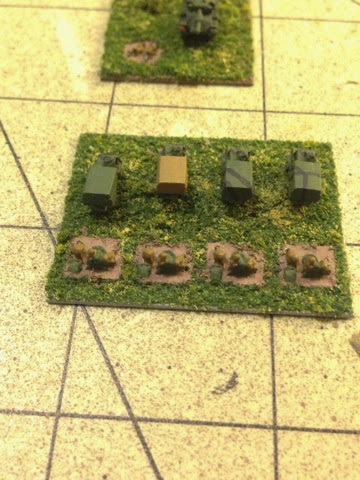
Here's my battery: three sections of guns:
an M113 Beobachtungspanzer for the forward observer:
the M548s that accompanied the guns:
and the battery commander's M577:
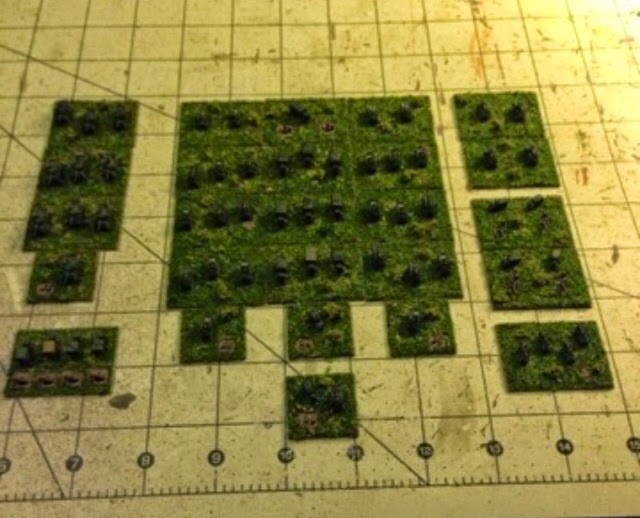
and finally, the whole battery:
I thought about snuggling the M548s up to the rear left side of the guns, but it made each stand look very packed in, so I went with doing them seperately. 

The M110's normal firing range was about 10.5mi/17km, out to a maximum of 15.5mi/25km (18.5mi/30km with rocket-assisted projectiles). So for just the normal range, I'll need a wargaming table 92ft/28m long!!! Well, the battery looks good, even if I never get to use it other than as an off-table firing asset. 

That's it for this weekend. I feel an aircraft post coming on....

Sunday, April 26, 2015

She's really cranking them out!!

During the recent research my wife did in order to paint a South Vietnamese M8 Greyhound ("Mrs. History PhD strikes again!" - April 13, 2015), she came across an article that described several ARVN M113A1's that had been locally modified by adding turrets to them taken from non-operational M8's. She (and I) found this intriguing, though no amount of Googling since then has managed to turn up a period image. Undaunted, my wife has forged ahead and I have provided the necessary bits and pieces for her very first kit-bashing!! 

M113A1's in South Vietnam, were they ARVN, US, or Australian, generally had the flat, rectangular trim vane (really just a breakwater) that you normally associate with the M113:
But not all did. Others had a modified vane that was supposed to cause less buffeting of the vehicle as it swam and provide additional flotation:
That being the case, I had just the item lying about. The unused hull of a GHQ M163 Vulcan with the modified vane. This had the added advantage of having a turret ring already cast onto it. 

So here is Mrs. History PhD's offering:

She's really taken to the "severely grubby" look that I prefer. If you've never spent time around military vehicles that have been in the field for more than an hour or two, take my word for it, you really cannot overdo the muckiness. I bought the wife a bottle of Mig Productions Vietnam Earth pigment powder:
which I have never used before, but I must say that I'm very impressed with it! If she keeps on like this, she'll bring back my "Vietnam fever"!

That's the weekend done, so more next time!

Monday, August 25, 2014

Danish Armored Reconnaissance Squadron

After the past weekend's break from my regular painting routine, it's back to the salt mine this week. East Germans and Danes. Danes and East Germans. 

This week, I'm finishing off a Danish armored reconnaissance squadron. In 1981, it would have consisted of two troops of light tanks; unmodernized M41 Walker Bulldogs:

Also three squads of infantry (some squadrons had four), each mounted in an M113A1:

And a platoon of six reconnaissance Land Rovers (likely to be 88's):
This particular photo is of a British Army reconnaissance 88, but the Danish ones would be configured more or less identically, but substituting MG3's for the L7 GPMG's:
As usual, O8 doesn't have armed Land Rovers, other than the 110 SOV, so I have to grit my teeth and use it. And they don't have 88's period.

The squadron commander would be mounted in a Danish home grown M113A1 command vehicle, as Denmark never bought M577's:
The only differences from a standard M113A1 were extra radios, a 1kw generator mounted on the top deck, and the internal bay was converted into a small "office". 

And everyone together for the obligatory group shot:
Officers in the rear. Isn't that always the way?

The upcoming three day weekend has me full of plans to get loads of painting done, while it has Mrs. HistoryPhD full of plans to prevent me from getting that accomplished. Need I say whose plans will win out?  See you next time!

Sunday, May 25, 2014

Danish mechanized infantry battalion, Part 2

I've devoted the final day of my long Memorial Day weekend to finishing off the last M113 company that has been missing from my Danish mechanized infantry battalion. So here is the battalion, with command, including the armored squadron and all support platoons, in all it's tiny glory. First a shot of the whole battalion:
Here's each of the two mechanized and one motorized infantry companies, and at the back, two M125 mortar carriers for each mechanized company and two truck-transported mortars for the motorized company:
Next, the armored squadron of Centurion V/2's:
And the eight TOW launchers, four M150's and four Land Rover mounted:
Then the four 120mm towed mortars:
Also, the Land Rover reconnaissance platoon:
And finally, the battalion commander:
I've slightly reorganized how I do my command stands, which I'll cover in my next post. You'll notice that I didn't include any infantry stands. I think of them as a separate problem. 

And the whole battalion fits neatly into two bunker boxes!

Tell me 3mm isn't the business!! And to top it all off, if you disregard the postage and the amount necessary for basing materials, the whole battalion cost me just $21(about £14 or €16)!! That gets just 10 vehicles with GHQ!!

More next time!