Sunday, October 4, 2015

The Japanese and the East Germans

Not exactly two groups that go together, but that's what I've been working on this weekend. 

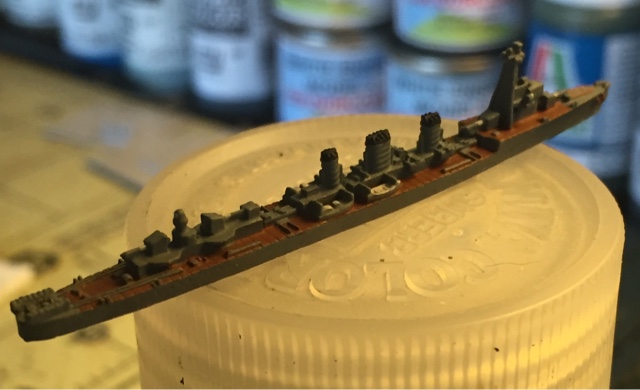
First, I finished off the Japanese light cruiser Tatsuta,
sister ship of last weekend's Tenryu, as well as the Kamikaze class destroyer Yunagi:
Recently on TheMiniaturesPage.com, when I mentioned having completed Yubari and Tenryu, someone said I'd soon have the entire line-up for the Battle of Savo Island. While I'm not specifically trying to do that, it seems as good a target to work toward as any, hence doing Yunagi. As you can see from my photos, I've run out of appropriate-sized ship bases, so an order went off to Bay Area Yards on Thursday. I really cannot recommend their bases highly enough!

And now the East Germans. In any WarPac division, regardless of nationality, there was always a radio/radar intercept and direction finding company as part of the reconnaissance battalion. The company's platoons would break down into sections and roam along the division's frontline, attempting to intercept and decode NATO radio transmissions. 

The vehicles used varied quite a bit, not only by decade, but also by unit. Each section was normally two vehicles; an intercept vehicle loaded with radios etc. and a data processing vehicle full of computers and intelligence analysts. In 1981 (my scenario date), one commonly seen combination was a UAZ-452 for the intercept:
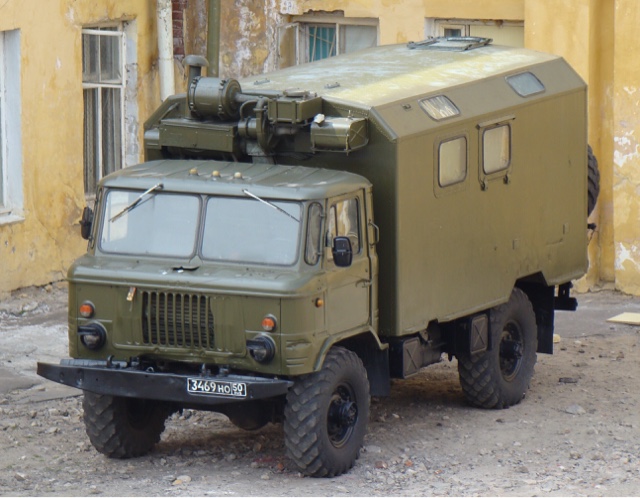
And an office-body GAZ-66 for processing:
(but with a lot more antennae than that one). Once NATO transmission sites had been located and the traffic decoded, the information was passed to division HQ for analysis and then immediately on to artillery units for targeting. 

Here's my version:
O8 doesn't make a box-body truck, except as part of the Ganef pack, so I'll just have to use a regular GAZ-66. I really ought to do 2-3 more stands of these guys. Just another thing to put onto the already burgeoning "to do" list. More next weekend!

Monday, September 28, 2015

Japanese light cruisers

In an uncharacteristic flurry of activity, I've finished two Japanese light cruisers! First, the Yubari:
Launched in 1923 and sole member of her class, the Yubari was very active during the Pacific war, including the Battle of Savo Island, and was finally torpedoed by the US submarine Bluegill in April 1944. 

I've also completed the Tenryu:
Likewise a victim of a US submarine (the Albacore in December 1942) and a veteran of Savo Island, where her torpedoes sank USS Quincy, Tenryu was the lead ship of her class of two (I have her sister, Tatsuta, in my painting queue) and was launched in 1919. She was also the oldest Japanese cruiser to fight in WWII.

Not a bad night's work!
Only about 600 more to go! Once I run out of my small stock of White Ensign's now defunct line of WWII naval paints, I'm going to be in a hard way!!

Sunday, September 27, 2015

T-80s!!

Never fear! Naval miniatures haven't totally supplanted 1/600 Cold War and I've finished off a company of Soviet T-80Bs to prove it:

In 1981, these beasts would've been a rarity, especially in LANDJUT, where the toughest opposition would have been West German Leopard 1A4s (the few Leopard 2s produced by then would have been held considerably further south). The very small number of T-80Bs available were mostly with Central Group of Forces (CGF) in Czechoslovakia or in the western military districts just inside the Soviet Union. A precious few T-80s were in Group of Soviet Forces Germany (GSFG), facing the British Army of the Rhine (BAOR) specifically to oppose the Chieftain tanks.

No matter which front you look at, T-80s were supplied at the rate of just one company per armored division. Therefore, my addition of a company for a LANDJUT campaign is entirely fanciful and purely a "what if", but they're just too cool not to have a few. So, here they are:

Like all O8 minis of second and third generation Soviet MBTs (T-64, T-72, T-80), these don't give a good impression of the squat, ground-hugging appearance of the real thing, but otherwise, it's quite a good looking model.

A productive weekend! Lots of half-finished projects polished off. And that's with Mrs. History PhD's "honey do" list thrown into the bargain! 

A shipment from Litko!

Yesterday, a small naval-themed shipment arrived from Litko. I've never ordered anything from them before, but they have an excellent section of naval accessories for the tabletop, so I got a few things as a test run.

Some small (as I'm using them for 1/2400) "burning" markers:
Is it just me or do they look like Marge Simpson's hair?

Some medium-sized "make smoke" markers, which would also be nice for "low-lying clouds":
And my absolute favorite, "rain squalls":
Those are really outstanding!!

Everything is acrylic and in 2-4 pieces, but very easily glued together. I'm extremely pleased with Litko's stuff and I'll definitely be ordering from them again (and again)!

Saturday, September 26, 2015

1/2400 scale flight stands

As my urge to paint 1/2400 WWII naval miniatures has resurfaced after 3 years in hiding, I've decided that I had better get more aircraft stands ready, so I can represent air strikes. 

I'm starting off with GHQ's Japanese B5N Kate torpedo bombers:
for no other reason than that I have to start somewhere. I cut a 1"x1" (25mm x 25mm) styrene square and drilled three holes in it. Then I superglued three bits of wire (all approx. 1" tall) into the holes:
I tried using quite thin wire at first (.015), but it was far too flexible and springy. After substituting wire thick enough to be rigid (.047), I put a tiny dot of Gorilla Super Glue Gel on the tip of each wire and added the aircraft. After they were dry, the whole thing got a light coat of black spray primer. 

After painting the base my usual "sea" color (see my post of Sep. 13, 2015), I left the wires black and painted the Kates:
Tough to get the tiny devils in focus.

I won't get into the thorny topic of what color early war Japanese aircraft were painted. Suffice to say that as B5N Kates were built by Nakajima, I went with the same color that the plant painted the A6M Zekes that it produced, a slightly greenish light tan. No, Zekes were never pale grey. Anyway, I have a largish bottle of Floquil Aged Concrete that was the exact shade. A coat of gloss and my Kates are ready for their first torpedo run! The hardest part of the whole process was getting those microscopic hinomaru on the wings and fuselage!

Having masses of aircraft stands cluttering the gaming table is highly annoying, so I don't try to model aircraft 1:1 (except for reconnaissance aircraft). Each stand can represent anything from a flight of three aircraft to a full squadron of eighteen. So, as I do with my ships, I mark the stand's edge with nationality and a stand number:
I keep track separately of how many aircraft each stand represents. Now I need to add steel paper to the bottom of the stand, so it can be stored in my magnetic-bottomed Bunker Boxes. 

Not a bad evening's work. Just a few dozen more to go. Ugh!!!

Saturday, September 19, 2015

Back in the USSR

I've been feeling distinctly unwell this weekend.
Thank heaven for Mrs. History PhD (and Teddy)!

Anyway, after a couple of weeks of fiddling with other things, I'm back to 3mm Cold War and it's Soviet tanks. We're back in the USSR ("You don't know lucky you are"). Despite my misery (mild food poisoning, not brought on by my wife's Thai cooking!), I've managed to finish the battalion command stand that I was lacking for a T-64A battalion which I had been working on earlier in the week (before I was cruelly struck down):
And the whole thing:
That's what I love about 3mm! Battalions really look like battalions. 

I had planned on using a BRDM-2:
as the second vehicle on the battalion command stand, given that each Soviet armored battalion had a section of them as a recon unit. However, wheeled vehicles mixed in with my tanks just rankles, regardless of the authenticity. So I swapped for a BRM:
which fulfilled the same role. I know, I know! But it's MY Soviet Army!

More after my recuperation!