Wednesday, June 17, 2015

A slight change of subtitle....

You may notice that I've made a small addition to the subtitle of my blog. I've added "& 15mm".

Given that Mrs. History PhD seems to have really taken to FOW Vietnam vehicles and given that my blog is 3mm/6mm oriented, I suggested that perhaps starting her own blog might be not only useful, but enjoyable. 
"Do what? I already have a blog. The one you write. Writing a blog is too boring for me". Sigh. 

So, my (our) blog has now been changed to reflect the new interest in 15mm. Ugh....
I get no respect, I tell ya

Sunday, June 14, 2015

50 followers!!


It took 23 months, but I'll take it! Thanks very much to all 50 of you, even you in the back there. Yes, you with the bizarre hat on. 

Saturday, June 13, 2015

Some Soviet armor, for a change

In my 1981 LANDJUT scenario, most of the WarPac forces I'll be fielding will be East German, but there will be smaller numbers of supporting Polish and Soviet forces. As far as the Soviets go, the majority of the troops committed in reality would most likely have been VDV (airborne and air assault), but it's quite probable that Soviet motor rifle and possibly armored forces would also have participated in the thrust northward toward the Danish border, at least as far as the Kiel Canal. 

That being the case, at some point in the far-flung and misty future, I'll need some Soviet ground troops, in addition to VDV. So, as a change of pace from my usual endless painting of East Germans, I've done some Soviet armor: T-62s!

By the early 1980s, the Group of Soviet Forces Germany (GSFG) had almost totally replaced its T-62s with T-64s in all armored divisions that were part of the 2nd Guards Tank Army and the 3rd Combined Arms Army (it stopped being the "3rd Shock Army" after the late 1950s) and they were well on the way to total replacement in the armored divisions of the 1st Guards Tank Army and the 8th and 20th Guards Armies. However, in all the motor rifle divisions of the GSFG, the replacement rate lagged well behind that found in the armored divisions and about half of their attached tanks were still T-62s. 

Here's the first company of a planned T-62 battalion for a Soviet motor rifle regiment:
Now just two more companies to go. I think I have too many irons in the fire for any of them to get really hot! I suppose most wargamers are the same. 

More from me next weekend. 

Monday, June 8, 2015

Mrs. History PhD's first FOW!

After working on it off and on for a couple of weeks, my wife has finished her first Flames of War Vietnam vehicle! For those of you that remember, it was an M577 that I bought for her as a birthday gift. 

I must say that I was not at all impressed with the casting or how poorly the (few) pieces fit together. All rather clumsy and it took a considerable amount of filing and trimming to get it together properly. The .50cal that was provided was a particularly dreadful and misshapen lump and looked NOTHING like what the website would lead you to believe:
Look at that pristine little Ma Duece! Definitely NOT what you get in the package. If I were Battlefront, I believe I'd be quite embarrassed. However, Mrs. History PhD has persevered and, in my opinion, turned out a very superior first effort:
(Please note that sole responsibility for the crap photography must be laid at my doorstep.) She says she still needs more stowage, which I have to buy for her, but overall, she's quite pleased with her end result. 

She's now decided that she wants to continue on in 15mm Vietnam. 
I should've seen this coming when I set her to painting in 6mm. She also says that 3mm is too small to be worth her time! 
Who's filling her mind with these horrible lies!?! 

In any case, I could already see that she was enjoying herself, so, good husband that I am, I was prepared: 
Always nice to know that I'm appreciated.

I can tell where this is all going to end:
Lord! We'll need a bigger apartment!

Sunday, June 7, 2015

Painting the Vietnam War, Part 1

Now that Mrs. History PhD seems to have been bitten by the Flames of War bug, she has asked for a bit of general advice on painting vehicles and troops for the Vietnam War. I believe she's interested in those little nuances that show realism and a familiarity with the timeframe. That being the case, I imagine my observations may be generally helpful to others too, or so I flatter myself to believe.

I'm not going to get into the politics of the war and whether it was right or wrong. The real world is never that clear cut; not now and not 50 years ago. Whatever the morality of the war was (and is), it's germane here only in so far as it does to some extent affect how miniatures are depicted. More on that in Part 2. 

If you already know the basics, please forgive me if this first part is a brief history lesson to bring any newcomers up to speed. For a number of years, I taught a 400/500-level senior undergrad/graduate class entitled "The Vietnam Quagmire". If you remember the Vietnam War clearly, as I do (the latter part), you can skip ahead to Part 2. 

Although it was Franklin Roosevelt who began America's interest in Vietnam by supplying the precursor of the Vietminh in their war of attrition against the Japanese, it was Harry Truman who first sent US "advisors" to Indochina in 1950 and supplied the French so that they could hold on to their colony. Dwight Eisenhower escalated the numbers of US military advisors in the new Republic of Vietnam in 1956, along with supplying a large amount of financial aid and military equipment. 

Although Eisenhower and then John F. Kennedy increased the involvement and numbers of US advisors (to 23,000), the "war" as it is now popularly perceived didn't begin until early 1965, when Lyndon Johnson, in response to the Tonkin Gulf Incident, increased American forces in South Vietnam, as well as drastically changing the nature of the war, by sending 5000 Marines ashore at Da Nang. 
US Forces continued to increase until January 1969, when there were 550,000 in South Vietnam and large numbers in Thailand and aboard ship in Southeast Asian waters, as well as US troops in The Philippines, Guam, and Okinawa in support roles. 

As wargamers, we can break the war down into five distinct phases:
1) Advisors: 1961 through early-1965, when US troops mainly guarded the airbases they used and ARVN troops did most of the fighting in the field, accompanied by small numbers of US advisors. 
2) Escalation: mid-1965 through the end of 1968, when US troops took over the bulk of the fighting in the field and there was still optimism that the war could be ended successfully.
3) Disillusionment: 1969 through mid-1970, when US troops and the American public both realized that there was no successful end to the war in sight.
4) Vietnamization and withdrawal: late-1970 through mid-1973, when the US handed the prosecution of the war back to the South Vietnamese. US troops were (mostly) withdrawn and those that remained return to an advisory and training role. 
5) Final Collapse: late-1973 through April 1975, the US washed its hands of the whole situation and walked away, cutting off all military aid to South Vietnam, which then rapidly disintegrated under invasion from the North. 

Obviously, all of the above is in very broad strokes, as the Vietnam War is too huge, too long, too convoluted, too divisive, and still too provocative of very strong emotions even 40 years later, to be able to do any justice to the subject on a little-read hobby blog. 

As an aside, as you read through all of the above, I hope it will all sound very familiar to you, given that you've heard it all again over the last 14 years and we're again in Phase 4. 
  
Each of the war's phases saw changes in attitude among US, Allied, and ARVN troops in the field, which in turn influenced the appearance of uniforms and vehicles and how we depict them on the tabletop. Part 2 of this post will begin discussing those changes. Stay tuned!


Friday, June 5, 2015

A PTS-M platoon (and a bone to pick with Marcin)

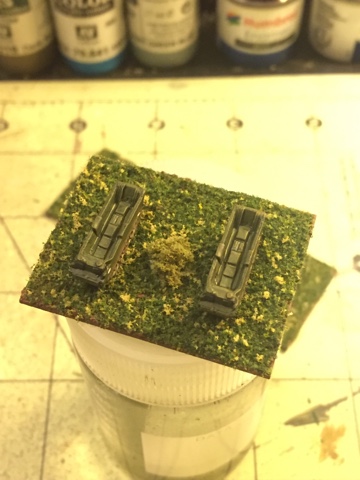
I picked up a few of O8's PTS-M amphibious transports and tonight I've finished them off for my East Germans.

Several platoons of these would've been assigned to particular rivers, bays, estuaries, etc. to ferry across towed artillery batteries:

Production began in 1965 and the PTS-M had a top road speed of 25mph and a maximum load of 5 tons in the water and 10 tons on land. It would hold 70 fully equipped troops for beach landings and it often was seen towing the companion PKP amphibious trailer. As well as general cargo loads, any light or medium truck in the Soviet inventory would fit into the vehicle. The PTS-M was succeeded in 1973 by the PTS-2, which looked basically identical, but was slightly bigger and could handle heavier loads. Like all superseded equipment in the WarPac, the PTS-M never really retired, as production of the PTS-2 never came close to meeting demand. 

Now I come to the bone I have to pick with Marcin. The real PTS-M would hold a URAL-375D or a Star-266, as you can plainly see from the photos above. The ZIL-157 would also fit. However, Marcin's models of all three of these trucks will NOT fit into his PTS-M mini. Either his trucks are too big for scale or (as I suspect is the case) the PTS-M mini is smaller than scale. Annoying!!

In any case, here's my platoon of East German PTS-M amphibious cargo vehicles:
And by way of my bonafides that trucks won't fit, here's a shot with a URAL-375D:
It perches on top because it absolutely will not fit between the gunwales. I would much rather display the PTS-M's with a vehicle load, however....

More next time. 

Thursday, May 28, 2015

The 2S9 Nona-S

During the mid and late Cold War, each Soviet air assault infantry (VDV) battalion was accompanied by a platoon of eight M-43 120mm towed mortars and their GAZ-66 prime movers:
as well as an independent battery of six at regimental level.

In the mid-1970s, design work began on a self-propelled version of the mortar, based on the BTR-D chassis, which would allow the weapon to more easily traverse difficult terrain and provide it with the ability to "swim". The GAZ-66 had (and still does have) an admirable but limited ability to ford water. In late 1981, the Nona-S began to enter service:
though it would be 1985 before it was fully integrated into the Soviet VDV forces. It had been planned to use the Nona-S to replace all the VDV's towed mortars, but instead, it was decided to group the new vehicles together at regimental level and only replace the M-43's that served there as an independent airborne motor battery.

So, the boiled down version is that the battalion level kept its towed mortars (at least into the late 80s) and the regimental level replaced towed with the new Nona-S. 

And here is my airborne mortar battery:
In all likelihood, the vehicles would've been grouped as three sections of two vehicles each, but the minis are quite small, so I went with three per stand. Two per stand just looked too naked.

The forward observer would have been mounted in a UAZ-469 4WD:

The battery commander presented me with a problem. In reality, he would've had a GAZ-66 R142 command vehicle:
but of course, O8 makes no sort of box-body Soviet truck, GAZ-66 or otherwise. So I finally decided to go with a standard GAZ-66:
A rather odd vehicle for a command stand, but I didn't really have much choice.

As my scenario begins on March 30, 1981 and the real Nona-S didn't begin entering service until later that year, I've stretched reality slightly and assumed the the Soviets would have pulled out all the stops and gotten new equipment ready in time for the planned hostilities.

That's all for my VDV for the moment. More in the next post.