Showing posts with label GAZ-66. Show all posts

Sunday, October 4, 2015

The Japanese and the East Germans

Not exactly two groups that go together, but that's what I've been working on this weekend. 

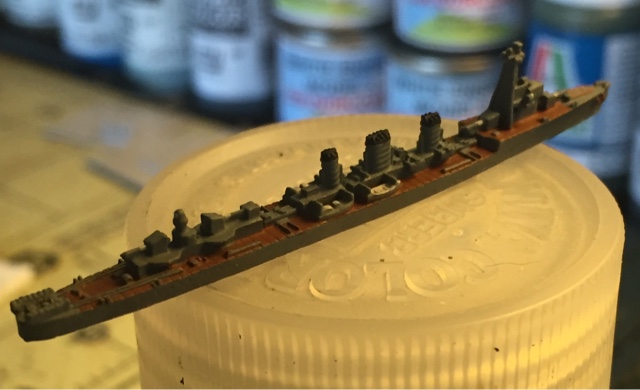
First, I finished off the Japanese light cruiser Tatsuta,
sister ship of last weekend's Tenryu, as well as the Kamikaze class destroyer Yunagi:
Recently on TheMiniaturesPage.com, when I mentioned having completed Yubari and Tenryu, someone said I'd soon have the entire line-up for the Battle of Savo Island. While I'm not specifically trying to do that, it seems as good a target to work toward as any, hence doing Yunagi. As you can see from my photos, I've run out of appropriate-sized ship bases, so an order went off to Bay Area Yards on Thursday. I really cannot recommend their bases highly enough!

And now the East Germans. In any WarPac division, regardless of nationality, there was always a radio/radar intercept and direction finding company as part of the reconnaissance battalion. The company's platoons would break down into sections and roam along the division's frontline, attempting to intercept and decode NATO radio transmissions. 

The vehicles used varied quite a bit, not only by decade, but also by unit. Each section was normally two vehicles; an intercept vehicle loaded with radios etc. and a data processing vehicle full of computers and intelligence analysts. In 1981 (my scenario date), one commonly seen combination was a UAZ-452 for the intercept:
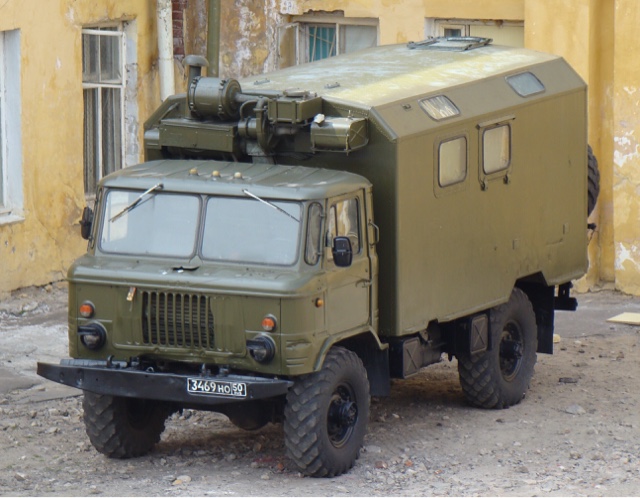
And an office-body GAZ-66 for processing:
(but with a lot more antennae than that one). Once NATO transmission sites had been located and the traffic decoded, the information was passed to division HQ for analysis and then immediately on to artillery units for targeting. 

Here's my version:
O8 doesn't make a box-body truck, except as part of the Ganef pack, so I'll just have to use a regular GAZ-66. I really ought to do 2-3 more stands of these guys. Just another thing to put onto the already burgeoning "to do" list. More next weekend!

Saturday, April 18, 2015

Soviet airborne assault guns!!

In addition to my ever-expanding masses of East Germans, I'm trying to get small units of supporting Poles and Soviets done and toward that end, I'm planning a VDV battalion (Soviet airborne and air-assault troops). 

Prior to the end of the 1960s, Soviet airborne units had been mounted in trucks; generally the air-droppable version of the GAZ-66. In order to give these troops some fire support, self-propelled assault gun units were added to the VDV TO&E. By the mid-1950s, the ASU-57:
was recognized as having too little punch. The days of the 57mm gun being effective were already long over. So a new, up-gunned vehicle entered service in 1959, the ASU-85:
its 85mm main armament having been derived from the D-48 antitank gun:

Like its predecessor, the ASU-85 could be palletized and airdropped:
or it could be loaded into the Mi-6 Hook heavy lift helicopter. The ASU-85 filled the role of light infantry support gun and was also capable of a limited antitank role. 

Beginning in 1969, the BMD-1:
began entering service, filling the triple roles of IFV, infantry support artillery, and antitank vehicle. However, it proved to be complicated and slow to build, as well as quite expensive, so in 1974 a simpler and cheaper APC was introduced, the BTR-D:
The BTR-D had no offensive weapon, so the planned retirement of all ASU-85's was scaled back, its firepower still being required for those units equipped with the new APC. 

Those ASU-85's that were retired found a new lease on life as city buses:
and several were entered into local demolition derbies, where they performed quite admirably:

The Poles and East Germans also operated the ASU-85 from the mid-60s through the mid-70s, but all of theirs had been retired by 1976.

And here is my ASU-85 assault gun company which will operate in support of my VDV battalion:
I just can't resist those blue berets. Even though the smallest maneuver element in Soviet doctrine was the battalion, on rare occasions, a company could operate independently. 

That's it for this weekend. More next time. 

Sunday, September 14, 2014

Soviet airborne antitank company

This week I've been working on an antitank company for my small but slowly growing number of Soviet airborne and air-assault troops (the VDV).

In the early 1980's, the company would have consisted of a platoon of six towed 85mm D-48 antitank guns. Here's a very good short video of the D-48 firing:


In 1981 these guns were already outdated, but as you can see from the video, they did still pack quite a punch. They would've been towed by the airborne version of the GAZ-66:
Here's what each stand will look like, with slight variations in the GAZ-66 tarpaulins:

The company's second platoon would have been made up of six BRDM-2 Konkurs antitank vehicles. This one is Czech:
And this one is Hungarian:
The missle launchers fully retract into the hull:


This vehicle is very often erroneously referred to as a BRDM-3, which it definitely was not. A real BRDM-3:
was (and still is) a reconnaissance vehicle derived from the BTR-80AK.

And finally, the antitank company's commander would have been mounted in a BRDM-2U:

That's it for now. More next time!

Tuesday, June 10, 2014

Polish airborne troops

A few posts ago, a reader commented that the Polish 7th Lusatian Landing Division was, in reality, committed to the Polish/Soviet air and amphibious invasion of the Danish islands (the LANDZEELAND area of operations) and as such, would've been too closely engaged and/or used up to devote any forces to LANDJUT. This is entirely true. However, as I responded, I quite like the 7th Lusatian and so I'll "edit" historical reality a bit and keep the option of using them in my game. After all, since the real one never happened (yet), this is MY WWIII. 

However, the reader made an excellent observation. The Polish 6th Pomeranian Air Landing Division, which was also to be committed to LANDZEELAND, would've been much more likely to spare troops to support operations in LANDJUT. Again, entirely true. So I've decided to include a few stands from the 6th Pomeranian in my force, if for no other reason than they had very attractive dark red berets (I could only find a color photo of their beret from the back):
Of course in combat they would've worn helmets, but as with my Soviet VDV, the red berets help me easily locate these stands on the table. 

And here are some of my Polish airborne:
An airborne antiaircraft company consisted of six ZU-23-2 guns towed by GAZ-66 prime movers and a UAZ-469 command vehicle.

Here's a couple of real airborne guns:
The above happen to be crewed by Soviet/Russian VDV (and for some odd reason, by only one crewman each), but you get the idea. You can see the GAZ-66's in the background. 

There were actually two basic types of GAZ-66, the standard version:
(That's a towed 120mm mortar inside its protective canvas cover in the foreground), and the air-dropable version:
As you can see, the cab was fully collapsable as a space-saving measure. Once the cab was reassembled, it was pretty well indistinguishable from a standard GAZ-66, at least at 1/600 scale.

As an aside, while researching the color of Cold War-era Polish military vehicle license plates (white, by the way), I came across a number of photos showing GAZ-66's with gray canvas covers. Most militaries use covers of one variety of green or another (which may or may not have a camouflage pattern on it) or a multitude of differing shades of "canvas", but I find the gray quite nice looking, so I'll be throwing one in now and again. 

That's it for this time. More next post! 

Friday, February 14, 2014

More East Germans and some Danes

Progressing with my East German motor rifle battalion this weekend. Here's half the 120mm M-43 mortar battery that provided fire support for each battalion (i.e. one stand of the two needed):
Needless to say, in reality, the mortars wouldn't be packed in so tightly and the GAZ-66 ammunition supply trucks would only be that close to drop off more shells and then would stand a bit further off until needed again. However, doing platoon stands and using 3mm minis requires/allows a bit of "artistic license". 

And not forgetting my Danes, I've completed a 120mm mortar battery for them too. The Danes actually used French-made Thomson-Brandt 120mm mortars:
But O8 makes only Soviet ones, specifically the M43:
So I have to use this for both NATO and WarPac forces. Luckily at this scale, it's not too noticeable. I just swap the GAZ-66 trucks for Unimog 1300L's and paint them in Danish colors:

I've also (almost) completed an East German BMP-1 company this weekend. 
As you can see, the command stand has a way to go yet, but the actual platoon stands are finished. In order to make the AT-3 Saggers stand out a bit more, I painted them a much brighter green (Vallejo Gunship Green 895) than the vehicle itself. I've seen wargamers with the Saggers painted in all manner of bright contrasting colors, but as in all armies, bright colors are training rounds. In the field, the last thing you want on your vehicle is a glaring aiming point for the other side to use. 

Now I just have to whip that command stand into shape.... More next weekend, if not before.