Friday, April 10, 2015

The Mi-6 Hook

This week I've fiddled around with two Mil Mi-6 Hook minis. Maybe I shouldn't say "minis", as these models are pretty damned large! Ok, they're not 1/32 scale, but for 3mm, they're big!!

The Hook:
was (and remains) the second largest helicopter ever to go into production, with a lift capacity of 26,400 lbs (12,000 kilos), surpassed only by the Mil Mi-26 Halo:
as you can see on this comparison chart. Click on the image and it should take you to a zoomable version:

What would've been the largest helicopter, and called the Mi-12, never went into production and only two test platforms were ever built:
I don't know as I'd even call that a helicopter, though technically it is. 

In any case, the Halo didn't begin entering service until 1983 and wasn't fully operational until 1985, so I have no use for it in my 1981 scenario. 

In the WarPac, only the Soviets and the Poles operated the Hook, so I've done one of each. The Polish one:

The majority of Soviet Hooks seem to have been in overall light grey:
which didn't really suit me. However, some poking around the Internet did turn up an example in green:
The same aircraft before and after restoration. Of course, museum examples can't really be relied on for historical accuracy, but I won't quibble, as I prefer the green:

The models are big enough that I could get legible aircraft numbers on them, but I decided not to. For me, the aircraft are a secondary concern on the wargaming table. They are merely graphic representations of air strikes and fast moving enough that they really aren't on the table long enough to bother with going into minute detail on them. 

More in the next post!


Sunday, April 5, 2015

A bit of minecraft

No!! Not that kind!! This kind:
As a follow-on to my two recent posts about engineers (March 8 & 28, 2015), I've added some minelaying and removal capability for my East German pioneers. 

As with most modern military forces, WarPac doctrine assigned the responsibility for sowing and removing landmines to the engineers. Though this capability was actually a divisional asset, it was often parceled out to the division's various regiments. As such, in 1981, an East German pioneer company assigned to an armored regiment would have had two GMZ-2 tracked minelayers:
As well as a couple of UR-67 mine clearing line charge vehicles:
The more modern UR-77:
had entered service only in 1979, and so, in 1981, would have been in Soviet units only. 

If you're not familiar with removing mines via line charge, the short explanation is that a small rocket is attached to a long cloth tube filled with explosives and it is then fired out over a minefield:
It lands on the far side (hopefully - tubes come in lengths up to 200 meters/approx 650 feet) leaving the cloth tube lying in and across the field. The explosives in the tube are then detonated:
and the sudden massive over-pressure causes sympathetic detonation of any mines within approx. 4 meters (13 feet) on each side of the tube (It's pretty much the identical method used during WWII, except then it was with Bangalore torpedoes). Of course, there are types of mines that are over-pressure-proof for just this reason, but that's another story. 

Pioneers assigned to a motor rifle regiment would have been equipped with the UR-67s, as well as two PMR-3 towed minelayers:
which could be towed behind any medium or heavy truck in the WarPac inventory. As you see in the above photo, racks of mines were loaded into the truck and a crew had to hand-feed them into the minelayer's chute:
Many armored units had only the PMRs, as there were never enough GMZs to go around.

Both the GMZ and the PMR were primarily for sowing antitank mines, specifically the TM-62:
which could be laid on the surface for snowy conditions or sub-surface using the layer's integral plow, which then replaced the sod after depositing the mines. Both the GMZ and the PMR sowed mines at a pre-set distance of 5.5 meters (18 feet) apart. 

And here are my GMZ-2 and UR-67 stands:
As well as a PMR-2 stand:
I had a few ZIL-157 trucks handy:
and with no other burning need for them, they were nominated.

That's the end of the long holiday weekend, but more painting is on the way for the next post.

Thursday, April 2, 2015

It's not exactly M*A*S*H*, but it'll do

I bought some army-style tents off of Shapeways not too long ago (see my post "A Shapeways shipment arrived" 3/2/15), so I've been wanting to make use of some of them. What better way than to do a little vignette of an East German forward field hospital?

The tents are a basic military type:
The minis come as large rectangular tents and small square ones. In general, field hospitals are nothing more than quite a few tents, all connected together:
So I used an 80mm x 40mm steel base and constructed my own. It doesn't really have a legitimate use in a wargame, but it's a nice little bit of table dressing:
GHQ decals throughout. 

For vehicles, I put on a Trabant Kübel (with the top down) and a URAL-375D:
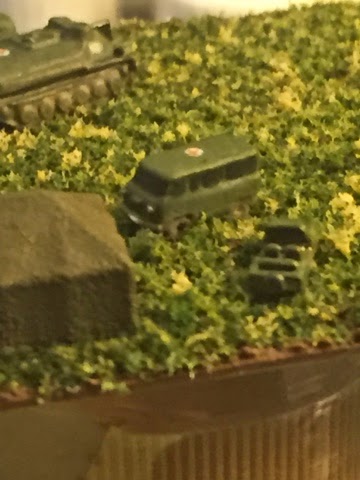
Just as miscellaneous staff vehicles. For the field ambulances that would have been constantly coming and going, I used an MT-LB and a couple of UAZ-452s, both having been used in reality:
As this will always be seen from above, I resisted the urge to put decals on the sides of the vehicles. Decals on 1/600 scale vehicles at all seemed lunatic enough to me, without pushing it any farther.
 
The UAZ-452, basically nothing more than a VW bus, was used in a variety of roles, such as post bus and for hauling light cargo:
But its main use was as a light field ambulance. 

Most forward hospitals had at least one helipad for medivac choppers, so I couldn't resist including one, especially when I saw this great camouflage scheme on a Polish Army Mi-2 Hoplite air ambulance:
Thanks to Wings Palette for that. Bright green and dark purple! I've got to have one of those!

As I said, I'll probably never have an actually need for this, but it was fun to create it. In future, I'll use the rest of the tents to do a West German hospital. This has helped me get the long Easter weekend's painting started (I don't have to work on Good Friday! Yay!!), so more as the weekend passes.