Saturday, July 5, 2014

More East German artillery

Continuing on with the theme of fleshing out the as yet anorexic artillery component for my East Germans, I've finished off a BM-21 Grad 122mm multiple rocket launcher battery, Grad meaning "Hail" in Russian:

The Soviets, and by extension the whole Warsaw Pact, loved multiple rocket launchers. This dated back to the Soviet use of Katyusha artillery rockets in WWII:
This sort of artillery, while not terribly accurate, is normally quite devastating because it totally saturates a given area and launchers are normally used in fairly large numbers, all operating in concert. 

Here's my battery:

When fully loaded, the rear of the launcher tubes are covered with an orangey-red cap which I imagine contains the primer for the firing mechanism:
That's why I've pained the rear of my launcher tubes Vallejo scarlet, which has a slightly orange tint to it.

R. Mark Davies, who is one of the real gurus of what army used what during the Cold War says that Grad batteries used 1V13 vehicles for their forward observers: 
And here's mine:

My understanding has always been that wheeled (ie towed) batteries used only wheeled command and FAO vehicles, while self-propelled batteries used only tracked vehicles. However, Mark says 1V13's for Grad batteries, so I certainly bow to his superior knowledge.

1V12 through 1V16 were all visually the same. The only difference being in the number and position of radio antennas. The NATO designator was ACRV M1974. 

So, I'm beginning to feel a bit better about my East German artillery, but I still have more to do before I'm satisfied. See you next weekend, if not before. 

Friday, July 4, 2014

Some harsh decisions have to be made

Given that the amount of spare time that I can devote to my hobby is finite and that the funds available for hobby purposes seem to be ever dwindling (everything else in life is getting increasingly expensive, but my salary stays the same) AND given Mrs. History PhD's increasing ire at the burgeoning amount of space my hobbies take up (in an already smallish apartment), I have come to the conclusion that harsh problems require harsh solutions. 
(As I added the above photo, Mrs. History PhD said "Look! You both have the same amount of hair!")

In any case, I've thought about my time periods and scales and come to the realization that, given that I'm anything but wealthy and that, at almost 52, I'll certainly never live long enough to paint and game with everything that I've already bought and bearing in mind that I'm definitely going to keep buying SOMETHING (addictions demand continued feeding), the following decisions have to be made:

WWII naval: I have approaching 750 or so 1/2400 scale ships and a number of packs of aircraft. 95% have been assembled and primed and put on a shelf. The other 5% never made it out of their blister packs. There will now be a permanent moratorium on further investment of time and money. I need to find a way to sell off this overly fragile lot. 

Early 80's NATO v WarPac: I started out doing this in 6mm and then soon duplicated the whole thing when I fell in love with 3mm. I have a fair few vehicles in 6mm, but my main investment is in quite a number of really gorgeous buildings, some no longer in production. This interest will now go forward in 3mm only. The 6mm vehicles will be sold off. My dear 6mm buildings, which I'm sentimentally attached to, will sit on a shelf and await further tortured deliberations.

WWII Western Desert: I began this in 3mm and while I still feel interested in it, work on it has been idling for 4-5 months now. As 3mm isn't overly space-consumptive, I'll pack this stuff away in a drawer and await renewed interest. 

Napoleonics: My interest in this (in 6mm Adler and I've thought about starting it in 3mm) seems more attached to the mind-boggling variety of beautiful uniforms and nations involved than in any real interest in actual gaming. Of course that didn't stop me acquiring a modest sized lead pile, mostly geared towards the 1806 Prussian campaign. A small percentage of the pile has been painstakingly painted and based, though not yet textured or flocked. This will now be halted and as much as possible will be sold off, given that it's all quite fragile (bayonets, swords, poles for standards). 

American Civil War: This is one of my first interests and is four decades old. My expansive 15mm collection was sold off years ago and 6mm took over, which was also sold off due to an intercontinental change of abode, so I actually have very little lead left. There is a small amount in 6mm and I have flirted with going to 3mm. I have to admit to myself that time and money will never allow me to return to my first love. You can never go home again, you know? So I'm going to stop fooling with it mentally and let it go. 

Vietnam: I began this several years ago in 6mm and I've invested considerable money and time into producing a very nice Brown Water Navy, as well as quite a lot of vehicles, terrain, buildings, etc. I briefly started over in 3mm, but Vietnam was not a war of maneuver, at least not on the ground. The terrain just would not allow it. Vehicles were used in small numbers and even singly, which just does not suit 3mm models. My continuing strong interest means this will be retained, but only in 6mm. The little work that I did in 3mm will be repainted and reused in NATO v WarPac (see above). 

And needless to say, all of the above areas of interest have their own associated reference books, paints which pertain only to them and have no application in other time periods, etc, etc. something will have to be done with all of that too. And it's quite a lot!

So there it is. 6mm Vietnam, 3mm NATO v WarPac, and 3mm WWII Western Desert will be staying. The rest have to go. Sad but necessary. If you'd like to buy any parts of a large pile of lovingly used lead, you know where to find me. I will mail!

And, yes, I AM going to stop buying things I don't need! Believe me. Why would I lie? Ssssssss....

Happy Birthday to my blog!!

Very Tiny Wars turns one year old today!!
As of this morning, I have 29 followers and 9253 page views (the vast majority by web bots). This is my 84th post in 52 weeks. Not bad. That averages out to one post every 4.34 days! Hopefully I haven't been too boring. We'll see what topics the next year brings. 

Thursday, July 3, 2014

Some Alpha Jets just landed!!

A small shipment from Dom at Dom's Decals arrived today. What a joy Dom is to deal with. Apart from some Soviet red star decals, as well as some Belgian roundels, I received a pack of Alpha Jets made by Tumbling Dice!! Yippee!!

The Alpha Jet was a joint project between Dornier and Dassault-Breguet in the 70's. Each company produced a very slightly different version of the aircraft. The Germans used them for light ground attack and the French only as advanced trainers. Of the other countries which purchased them, Portugal and Belgium both used theirs as dual-role; ground attack and training. The aircraft began entering frontline service in 1979 and the last were delivered in 1991. 

The two versions are fairly easy to tell apart. Those built by Dornier have a very sharply pointed, stiletto-style nose:
While those built by Dassault-Breuget have a rounded nose:
This being one of those that the Belgians bought. 

The Alpha Jets that TD makes seem to be the French version:
But a bit of judicious filing on the nose should easily turn it German. A very nice little sculpt. The only downside is that very few 1/600 scale aircraft seem to come with underwing stores, which is a damned shame. 

As I now have six, I'll paint four as West Germans (I can't foresee ever needing more than that) and the other two I'll do as Belgians, as I don't imagine I'll find a need for Portugese attack jets anytime soon. I'm quite pleased with these little guys. Let's start drilling mounting holes in their bellies so we can get them primed!!

Tuesday, July 1, 2014

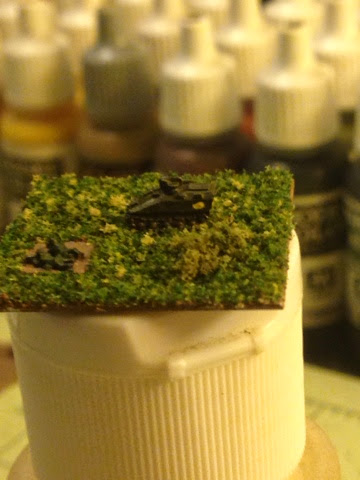
A bit of philosophy on painting 3mm

Over the past few weeks on TheMiniaturesPage.com, on a number of different threads, the topic of which way to go about painting 3mm minis has cropped up. 

I have noticed a marked sameness about the answers that were posted. "You need to paint MUCH lighter than you normally would" and "always use contrasting flock" pop up almost on cue. So I've been moved to provide my views on this, even though I once did a post on nothing but my 3mm painting philosophy. 

First off, you don't NEED to paint in any style, least of all in a style someone else thinks you ought to. Militaries, from time immemorial right up until this very minute, use differing shades of the same paint because they use multiple suppliers. No two vehicles have been exposed to wind/sun/rain/heat/humidity for the exact same amount of time. No two vehicles have had the same amount of time pass since their last overhaul and repaint (anytime a vehicle has major work done on it at the motor pool, it always gets repainted before it leaves).

Most wargamers (and indeed modelers) want to get as close to reality as is feasible with their painting, terrain, etc, and I'm no exception, but I'll be the first to admit that 1/600 scale minis do benefit from a slight "tweaking" of what the full-sized vehicle would look like in reality. The same can be said for 3mm terrain, including vehicle bases. 

Let's be honest. These things are damned small! And they're small so that large games can be played at 1:1, or close to it. In a large game with a large table, I can get an entire 1:1 division on the board without crowding. So, "table loss" is a reality here. At 4-6 feet away, with realistically colored terrain and bases, you definitely can lose quite a few of these suckers on the table. So, going a bit lighter with the paint colors and the shade of flocking can definitely have a beneficial effect. A bit!

However...I can honestly say that I have seen other folks' minis which seem to need "Ringling Bros" painted on the sides. Virtually neon circus wagons. Now, to be sure, those folks should paint in a style that pleases them. Whether I like it or not is immaterial. Whether it looks even vaguely realistic or not is also immaterial. If they like it, that's all that matters.

I, on the other hand, like my vehicles to be closer to REAL reality. Sometimes I hear that my paint doesn't provide enough contrast and that my flocking is too close to the color of the vehicles. I disagree. The whole purpose behind painting military vehicles is to help them blend into the background (along with helping to protect the metal). I use a shade of flocking that is just slightly lighter than the vehicle. I want what I paint to be as close to reality as is possible without losing too many things on the tabletop. I go slightly lighter on the flocking shade I use, but I'm NOT going to use flock that makes it look like my vehicles are on the fourth green at Pebble Beach! I also give each vehicle a bit of bright, but historically relevant color ("bling").

So, as this is my blog and therefore it's about my opinions, I'll say that the knee-jerk "paint it way lighter" neon minis I see do NOT look even vaguely like real military vehicles. If mine are too dark and too realistic and don't have enough contrast to make them "pop", they're that way because that's what's realistic and I'm good with that. So can we get the game started now?

Sunday, June 29, 2014

What does one do with a few spare howitzers?

Some time ago, I bought a pack of M109 self-propelled 155mm howitzers. The basic, non-upgraded sort, as that's what the Danes used. After making up a battery (I can't see my Danes ever needing more than that), I'm left with another battery's worth. Seems a shame to let them go unused. After a bit of research, the only countries in Northern Europe still using basic M109's in 1981 were Denmark, Britain, and Belgium. I have no use for a Belgian battery in the foreseeable future, however....

Here's an early 80's Belgian M109:
And here's my battery:
The Belgians used British-made Sultans as battery command vehicles:
And a pair of Spartans would've served each M109 battery as Forward Artillery Observer (FAO) vehicles:
I quite like the yellow vehicle numbers on the sides of the Spartans, so I've "extrapolated" the idea to the other vehicles too. I think in future, all Belgian tracked vehicles that I do will have yellow numbers. 

Ammunition supply vehicles would likely have been Unimog 1300L's:
as I can find no evidence that Belgium ever acquired any M548's. However, since I have no real use for this battery at the moment and because I go through quite a lot of Unimogs (Danes, West Germans, etc used them too), I'll not commit scarce resources (six Unimogs) to these Belgians until I find a need for them. Whenever that happens, then I'll make up the ammunition supply stands. 

Ok, more from me over the long Fourth of July holiday weekend!

Saturday, June 21, 2014

Wait! Where's the artillery!?!

Recently, while looking over my East Germans and planning what items I still need to buy and paint for them, I was stunned by a realization. I have absolutely NO East German artillery whatsoever!! Neither towed nor self-propelled!! How could this have happened!?! So, as a stop-gap until I can make a full order of artillery, I added a bag of D-30 122mm towed howitzers to an order I was sending to Picoarmor that day. 

Here's one of the three stands of two guns each (one section) that I made up for a battery. This is them superglued to the stand and primed:
They're very nice little sculpts, with three crewmen each. Here's the real thing for comparison:

And here's the whole battery: 

I've paired this battery with some URAL-375D prime movers. I'll still need to make up an FAO (Forward Artillery Observer) stand with a 1V18 vehicle:
Basically just a BTR-60PB with the gun barrel filed off of the turret. 
That'll be the next project. 

Whew, I feel better now. My poor East Germans were naked!! More in the next installment!

Thursday, June 19, 2014

LANDJUT campaign background: Jan-Mar 1981

In this blog entry, I'll begin to weave a bit of historically plausible "could have happened, but didn't" into actual historical facts. 

In January 1981, this was the NATO v WarPac map of Europe (Spain didn't join NATO until 1982). As the year began, the situation seemed to be getting ever worse, from the Soviet viewpoint. The unrest in Poland, with the Solidarity movement as its focal point, was growing stronger by the day. The staunchly anti-Communist American President-elect Ronald Reagan was set to take office on January 20th. The situation in Afghanistan was slowly deteriorating and pulling in ever larger numbers of Soviet troops. Something had to be done!

The military exercise that had been held in late May and early June of 1980, called "Spring 80", had been the largest the Warsaw Pact had ever held, until the Fall, when it was repeated on a yet larger scale, "Soyuz 80". Intended to intimidate the Polish government and people, they appeared to have had little or no effect. So, the Soviets scheduled a second and even larger exercise, "Soyuz 81", for the 17th-22nd of March, to be taken part in by all WarPac countries, save Romania, which had refused to actively participate in the Warsaw Pact since 1968 as a protest at the invasion of Czechoslovakia. 

As January arrived, it was not lost on Soviet planners that some of NATO's key members were at less than the pinnacle of military readiness. The United States was in the midst of a handover of power to the incoming new President. The old national security staff would be leaving and the new staff would need time before they were comfortable and efficient with their tasks. The West Germans had just begun a major restructuring of their army, some units having already received new equipment and training while other units still retained the old organization. The French continued to refuse to participate in NATO, being a member in name only, as they had been since 1966. The Greek military, after withdrawing from NATO in 1974, during the crisis in Cyprus, had returned to full cooperation only a few months previously. Very soon, the US forces in West Germany would begin to swell in preparation for the year's NATO military exercise, REFORGER 81 in September. If the Soviet Union was to upend the balance of power in Europe and, in the process, come to grips with their own growing problems, the time would never be better. 

The upcoming Soyuz 81 exercise was only some two months away. The Soviets had already given notice of them to NATO headquarters in Belgium, as was customary, to forestall any misinterpretation of the necessary buildup and movement of troops and matériel. It would be the perfect cover. It need only be extended for an extra eight days. 

In the most secure recesses of the Kremlin, a plan began to take shape. Would it be possible to put all things into motion in so little time? Directives were urgently sent to all KGB and GRU operatives in the United States; recruit a very particular sort of asset. 

By the beginning of March, Reagan had taken office and the American hostages in Iran had been freed. The Soviet plan was almost ready. Everything would have to be timed precisely. There would be no margin of error. The Romanian leader, Nicolae Ceaușescu was summoned to Moscow and told bluntly that in what was to come, he could be an ally or an enemy. There would be no middle ground. Ceaușescu blanched at the implication and chose to be an ally. He immediately rushed back to Bucharest to reintegrate his military into the WarPac command structure. Similarly, Cvijetin Mijatović of Yugoslavia was told that while his participation was not expected, transiting Yugoslav territory or airspace might be necessary and his quiet acceptance was required. Like Ceaușescu, Mijatović chose survival. 

Plans began to fall into place....

Tuesday, June 17, 2014

Marcin, are you listening?

Marcin!! Oh, Marcin!! 

Marcin, who is the moving force behind Oddzial Osmy, if not the outright owner, has in the past exhibited a willingness to listen to his customers via the Yahoo 1/600 group as well as on TheMiniaturesPage.com.

So, just in case Marcin should grace my humble blog with his presence (and as an amusement for myself), here are twenty-one items I wish O8 would add to their 3mm product line. So, without further ado, in no particular order: 

1) An M548:
This US-made tracked cargo vehicle was (and indeed still is) used by numerous countries, not the least of which were the US, UK, West Germany, Netherlands, Greece, Turkey, and South Vietnam. You really can't make a correctly equipped self-propelled artillery battery for these countries without M548's. 

2) A staff/liaison/command vehicle for West Germany; either a Munga:
Or an Iltis:
Or I'd even take a Type 181:
O8 makes similar vehicles for the US, Soviets, and British, so why no German vehicle?

3) An US M60A1 with the Xenon searchlight:
O8 makes the M60A3, so why no A1?

4) A Dutch DAF 328 truck:
No way to have a correctly equipped Dutch force with it. 

5) An M113 C&R 25:
O8 makes the M113 C&R 50:
But not the more widely used 25.

6) A Dutch YPR-765 PRAT, the antitank version:

7) A Soviet S-60 57mm towed antiaircraft gun, very widely used by all WarPac armies as well as the North Vietnamese, among others:

8) A Czech-made Tatra 8x8 heavy truck, used by the Czechs and East Germans:
 
9) An M113-mounted Green Archer battlefield surveillance radar:
Used by a number of different NATO armies. 

10) O8 makes a couple of different Soviet medium range battlefield missiles, but no US/NATO ones. Maybe a Lance:
Or a Pershing I:

11) A medium range Soviet SAM missile, such as an SA-4 Ganef:
Or preferably an SA-6 Gainful:

12) And if the WarPac gets a heavier SAM launcher, NATO should have one too. An I-Hawk missile, either tracked:
 Or towed:
Used by pretty much all of NATO.

13)  LARS I multiple rocket launcher: 
O8 makes the LARS II, which began to enter service in the mid 70's, but by the early 80's the upgrade wasn't yet complete and both systems were being used simultaneously:

14) M75 armored personnel carrier:
An American-made APC that was used in large numbers by the Belgians, who didn't begin using M113's until 1982-83. 

15) AMX-VCI armored personnel carrier:
A French-made vehicle that was also heavily used by the Belgians until 1982-83. 

16) Fiat G-91R Gina ground attack aircraft:
Used by several NATO countries and not finally retired until about 1982.

17) A US M1 155mm towed howitzer:
Used by pretty much every NATO country as well as South Vietnam, Taiwan, South Korea, etc. 

18) An M108 self-propelled 105mm howitzer:
Again, heavily used by the Belgians, as well as by the US in Vietnam. 

19) A Soviet AT-T prime mover:
Or at least the smaller AT-L: 
Both used by all WarPac armies.

20) A West German Roland self-propelled SAM:
An 80's Bundeswehr "must".

21) And finally, an Alouette II helicopter:
The main light observation helicopter used by Belgium.

So that's my list. Needless to say, it's all geared toward my chosen timeframe, 1981 NATO v. WarPac. It's not a scientifically generated list and maybe it represents no one's interest but my own. But after all, it's MY blog! What's on your list?